Piedmont Forklifts: Service, Sales, Rentals – Woman Owned, Spartanburg, South Carolina
The lithium-ion question gets argued as a chemistry question. It is really three questions about your building: power cost, battery-handling labor, and charging floor space.
Only one of those three is cheap in South Carolina.
Power is the least of it here
South Carolina industrial customers paid an average of 6.84 cents per kilowatt-hour in 2024, according to EIA. The national industrial average was 8.13 cents, in figures published that October. Commercial accounts ran 10.64 cents here against 12.75 nationally.
Power in this state is roughly a sixth cheaper than the country at large. So an argument built on energy savings alone carries less weight in Spartanburg than in New England.
If electricity is not the swing factor, something else has to be.
Labor and floor space are the swing factors
A lead-acid fleet running multiple shifts does not simply plug in overnight. It swaps. Each swap means a trip to the change room, a hoist cycle, a queue, and a trip back.
Multiply a few minutes by several swaps a day across the fleet. The figure stops looking like a rounding error. A change room is also warehouse square footage doing no picking, plus hoists, spill containment and ventilation.
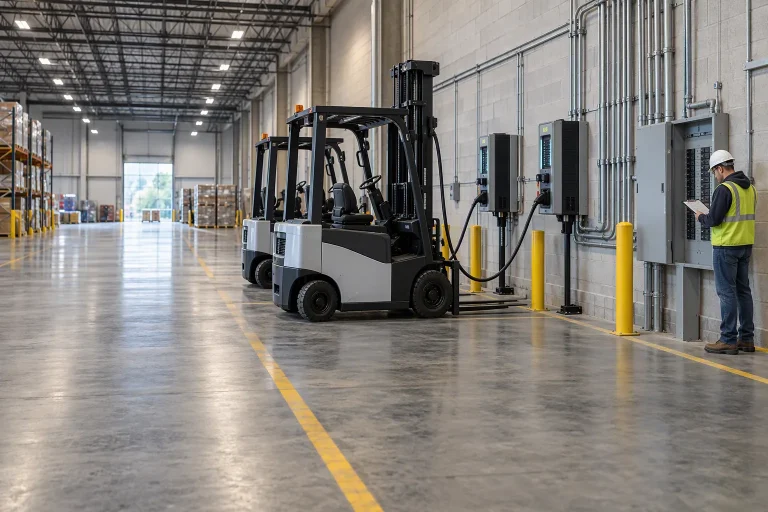
Lithium-ion fleets avoid most of that by charging in place during breaks rather than swapping. The saving is labor and real estate, not electricity. It also changes the compliance footprint. Charging in the truck and pulling batteries in a change room sit under different OSHA obligations.
What the grid-to-work number shows
Conversion losses are larger than most budgets assume. Argonne National Laboratory put lead-acid battery efficiency at 76 percent and charger efficiency at 84 percent. Multiply the two and only 64 percent of grid electricity does useful work. In practice you buy roughly 1.56 kilowatt-hours for every one delivered.
The same study put usable depth of discharge at 80 percent. A full charge takes about eight hours, followed by a similar cooling period. Together those facts are why a round-the-clock operation owns three batteries per truck.
That report dates from 2008, and the lead-acid figures in it have not been superseded by anything federal since. Treat them as the physics rather than as this year’s market.
What federal data does not tell you
Here is the part most comparisons skip. There is no federal or national-laboratory dataset publishing lithium-ion efficiency, cycle life or opportunity-charging performance for forklifts specifically.
The numbers circulating on that subject come almost entirely from battery manufacturers and equipment dealers. They may be accurate. Each one is also written by somebody selling the product, and none is independently verifiable.
So the useful posture is skeptical rather than dismissive. Ask any vendor where a quoted figure was measured, under what duty cycle, and by whom.
Measure your own building first
Four numbers settle this better than any comparison article, and you already own all four.
Shifts per truck per day.
Single-shift operations rarely justify the conversion. The case strengthens as shifts stack.
Battery handling hours per week.
Time somebody actually doing swaps, including the walk and the wait. Annualize it at a loaded labor rate.
Change room square footage.
Price it at what the rest of your warehouse earns per square foot.
Monthly kilowatt-hours per truck.
Your utility bill and hour meters give you this. At South Carolina rates it will likely be the smallest of the four.
Run those before the quotes arrive, because the answer is building-specific and a vendor cannot compute it for you.
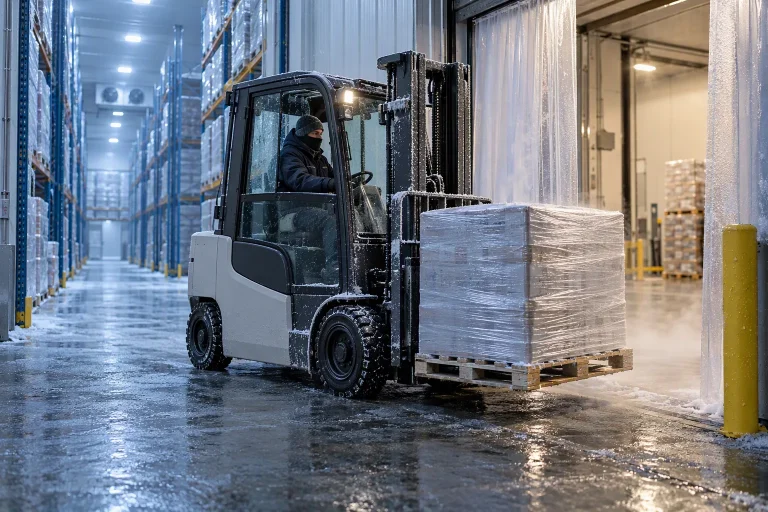
One variable changes the whole calculation. If any part of the operation runs below freezing, battery behavior shifts. Cold storage imposes constraints a dry-warehouse comparison will miss.
Lithium-ion forklift batteries win on labor and space far more often than they win on power. In a state with cheap electricity, that distinction decides the answer.
FAQ
Frequently Asked Questions About Lithium-Ion Forklift Batteries
Are lithium-ion forklift batteries worth it in South Carolina?
Often, though rarely for the reason given. South Carolina industrial power averaged 6.84 cents per kilowatt-hour in 2024 against 8.13 cents nationally, so energy savings carry less weight here. The case rests on battery-handling labor and the warehouse floor space a change room occupies.
How many batteries does a lead-acid forklift need for round-the-clock work?
Three per truck is typical for continuous operation. Argonne National Laboratory attributes this to a full charge taking roughly eight hours followed by a comparable cooling period, which leaves one battery working, one charging and one cooling down. Single-shift operations usually manage with a single pack.
Does switching to lithium-ion mainly save electricity?
No. The larger savings are battery-handling labor and warehouse floor space, because charging happens in the truck during breaks rather than through swaps in a dedicated change room. In a state with power costs below the national average, the electricity line is usually the smallest of the three.
Why is there so little independent data on lithium-ion forklift batteries?
No federal agency or national laboratory publishes efficiency, cycle life or opportunity-charging figures for lithium-ion forklifts specifically. Almost every number in circulation originates with a battery maker or equipment dealer. Ask where any quoted figure was measured, under what duty cycle, and by whom.
What should I measure before deciding on lithium-ion?
Four numbers you already own: shifts per truck per day, weekly hours spent handling batteries, square footage tied up in the change room, and monthly kilowatt-hours per truck. Run them before quotes arrive, since the answer depends on your building rather than the chemistry.
Piedmont Forklifts: Sales and Service Across the Upstate
Piedmont Forklifts is a woman-owned forklift sales, rental, and service company in Spartanburg, South Carolina. We work on every make and fuel type, so one shop covers a mixed fleet.
Our Services Include:
- Forklift SalesInspected pre-owned forklifts matched to your load, lift height and aisle width
- Forklift Service and RepairSame-day service across the Upstate on every make and fuel type
Weighing a fleet conversion? Contact Piedmont Forklifts with your shift pattern, your truck count and what your change room occupies.
Works Cited
- Gaines, L.L., et al. Full Fuel-Cycle Comparison of Forklift Propulsion Systems. ANL/ESD/08-3, Argonne National Laboratory, Oct. 2008, publications.anl.gov/anlpubs/2008/11/62912.pdf.
- United States, Energy Information Administration. “2024 Total Electric Industry – Average Retail Price.” Electric Sales, Revenue, and Average Price, Table 4, 7 Oct. 2025, www.eia.gov/electricity/sales_revenue_price/pdf/table_4.pdf.