Piedmont Forklifts: Service, Sales, Rentals – Woman Owned, Spartanburg, South Carolina
Anyone pricing an electric forklift fleet this autumn is doing it without the federal credit. That window closed on June 30, 2026, and the arithmetic changed with it.
The credit that is no longer there
Section 30C covered charging equipment placed in service between January 1, 2023 and June 30, 2026. Businesses could claim 6 percent of depreciable cost, capped at $100,000 per item. That rose to 30 percent where prevailing wage and apprenticeship requirements were met.
Two details matter for anyone who assumed they missed out on something large. The 30 percent tier was conditional, not automatic. Property also had to sit inside a qualifying low-income or non-urban census tract. That ruled out a great many industrial sites.
So the honest framing for a 2026 budget is that charging infrastructure is now a straight capital cost. Price it that way rather than waiting for a credit to come back.
Charging in the truck is not the same as a battery room
The bigger cost driver is a choice most operations make without realizing it carries compliance weight.
OSHA treats a charge-in-place area and a battery-changing room as different animals. A 1978 agency directive, still in force, exempts charge-only areas from the heaviest requirement in the standard, paragraph (g)(2). That paragraph covers four things: facilities to flush and neutralize spilled electrolyte, fire protection, protection of the charging apparatus from truck damage, and ventilation for gassing batteries.
The exemption is narrow. It applies only where no maintenance happens, batteries never leave the trucks, and no electrolyte is present. Miss any of the three and the full requirement returns.
Plenty does not go away under the exemption:
- The charging area still has to be designated for the purpose
- Trucks still get positioned with the brake applied
- Vent caps still get checked, with covers open
- Smoking stays prohibited
- Open flames and sparks still have to be guarded against
- Metal objects stay off the tops of uncovered batteries
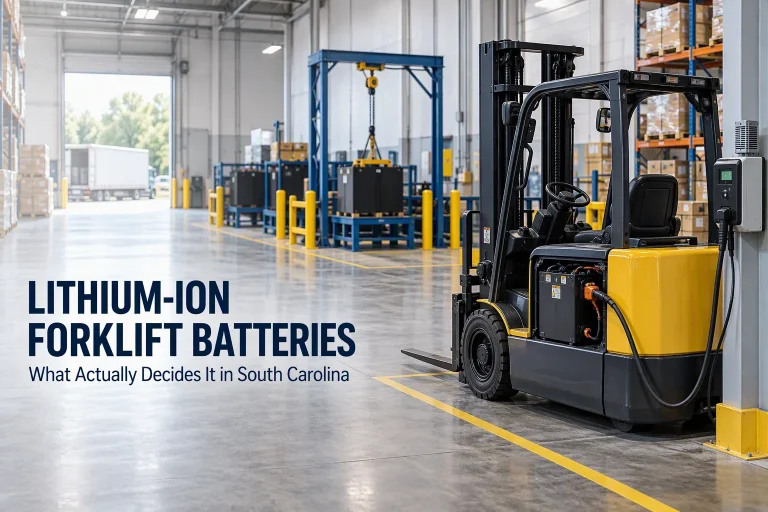
That distinction is worth real money. A change room needs floor space, hoists, spill containment and ventilation. An in-truck charging line needs electrical capacity and not much else.
Chemistry drives which path you are on. A fleet that charges in place during breaks avoids the change room entirely. That is one reason the lithium-ion and lead-acid comparison is really an infrastructure question.
What the electrical side actually involves
Charging equipment is a continuous load. The circuit serving it gets sized above the nameplate draw rather than at it. Several trucks on the same line add up quickly.
Three questions decide whether the install is cheap or expensive:
Is there spare capacity in the panel?
A warehouse built around lighting, docks and compressors may have little headroom. Finding out costs an electrician’s visit. Discovering it late costs a transformer.
Where is the service entrance relative to the charging line?
Distance is conduit, trenching and labor. A line near existing distribution costs a fraction of one placed wherever the floor plan left room.
How does your utility bill demand?
Many commercial accounts carry a demand charge. It is set by the highest short interval of use in a billing period. Charging several trucks at shift change can set that peak for the whole month. Staggered charging is an electrical decision, not a scheduling preference.
The sequence that avoids the expensive surprise
Get the electrical assessment before the equipment quote, not after. The panel answer decides whether you are buying chargers or chargers plus a service upgrade. Those are different orders of magnitude.
Then decide charge-in-place or change room. That sets your floor space, ventilation obligation and compliance footprint.
Only then price the trucks. Fleets that work in this order find the infrastructure answer shapes the chemistry choice, not the reverse.
One more variable if any part of the operation runs cold. Charging behavior and battery capacity both change at low temperature. Cold storage adds constraints a dry-warehouse plan will miss.
Forklift charging infrastructure cost is mostly not the chargers. It is the building, the panel, and which of two compliance paths you picked before anyone measured anything.
FAQ
Frequently Asked Questions About Forklift Charging Infrastructure
Is there still a federal tax credit for forklift charging equipment?
Not for anything installed now. The section 30C Alternative Fuel Infrastructure Tax Credit covered property placed in service through June 30, 2026, and that window has closed. Budget current charging work as a straight capital cost rather than waiting for the credit to return.
Do I need a separate battery charging room?
Only if batteries come out of the trucks. OSHA treats charge-in-place areas differently from change rooms, and a charge-only area avoids the heaviest requirement in the standard. Pull batteries, perform maintenance, or have electrolyte present, and the full obligation applies.
What does OSHA require in a forklift battery charging area?
Charging has to happen in a designated area. Trucks get positioned with the brake applied, vent caps checked with covers open, smoking prohibited, open flames and sparks guarded against, and metal objects kept off the tops of uncovered batteries. Change rooms carry further requirements.
Why does charging several forklifts at once raise my power bill?
Many commercial accounts carry a demand charge set by the highest short interval of use in a billing period. Starting every charger at shift change can set that peak for the entire month, which makes staggered charging an electrical decision rather than a scheduling preference.
What should I check before buying forklift chargers?
Panel capacity first, then distance from the service entrance to where the chargers will sit, then how your utility bills demand. Those three answers decide whether you are buying chargers or chargers plus a service upgrade, and the gap between those is substantial.
This article is general industry information and is not a substitute for OSHA powered industrial truck training, your employer’s safety program, or the operating manual for your specific equipment.
Piedmont Forklifts: Service and Rentals Across the Upstate
Piedmont Forklifts is a woman-owned forklift sales, rental, and service company in Spartanburg, South Carolina. We work on every make and fuel type, so one shop covers a mixed fleet.
Our Services Include:
- Forklift Service and RepairSame-day service across the Upstate on every make and fuel type
- Forklift RentalsDay, week, or multi-month rentals sized to the job
Planning a charging line? Contact Piedmont Forklifts with your truck count, your shift pattern and where your panel sits.
Works Cited
- United States, Department of Energy. “Alternative Fuel Infrastructure Tax Credit.” Alternative Fuels Data Center, afdc.energy.gov/laws/10513. Accessed 10 Oct. 2026.
- United States, Occupational Safety and Health Administration. “29 CFR 1910.178(g)(2); Battery Charging Stations for Fork Lifts and Other Industrial Trucks.” Directive STD 01-11-004, 30 Oct. 1978, www.osha.gov/enforcement/directives/std-01-11-004.