Piedmont Forklifts: Service, Sales, Rentals – Woman Owned, Spartanburg, South Carolina
South Carolina has twelve refrigerated warehouses. Between them they hold 76.8 million cubic feet of gross space, according to USDA. Those figures were collected on October 1, 2025 and published in February 2026. Seven are public, five private or semi-private.
Twelve buildings is a small number. The forklift problems inside them are not small. They also look nothing like the problems in a dry warehouse across the road.
Cold storage is not one temperature
A single refrigerated building often runs several climates at once. The receiving dock sits near ambient. Coolers hold somewhere above freezing. Freezers run well below zero. Any truck working the whole building crosses all three, repeatedly, every shift.
That cycling is the root of most cold-storage equipment trouble. It is not the cold itself.
Condensation is the real adversary
Move a cold mast into warm humid air and moisture condenses on every steel surface. Back in the freezer, that moisture becomes ice.
The damage shows up in predictable places. Water tracks into electrical connectors and corrodes pins. Ice builds in mast channels and on chain links, which stiffens travel and accelerates wear. Condensation on the overhead guard drips onto the operator. Frost on the carriage hides cracks an inspection would catch.
Trucks specified for cold work handle this with sealed connectors, conditioned hydraulic fluid, heated operator positions and corrosion-resistant finishes. A standard truck moved into a freezer does not fail on day one. It fails in month seven, and the invoice reads like a dozen unrelated faults.
Power source belongs in that specification too. Cold changes how a battery delivers and accepts charge. That makes the choice between lithium-ion and lead-acid sharper here than in dry storage.
Doorways cost more than they look
Every pass through a freezer doorway drags warm humid air into a space that has to remove it again. Forklift traffic is a large contributor, since trucks hold doors open longer than people do.
Three operational habits do most of the work here:
- Route trucks so loads stage on the warm side, not the cold one
- Batch trips instead of making single-pallet runs
- Treat door discipline as an operator training item, not a facilities problem
Those habits also cut the condensation load, which means less corrosion on the fleet. Refrigeration savings and equipment life move together.
Your operators are an equipment variable
NIOSH guidance on indoor cold work is written for exactly these rooms. The thresholds are concrete. Protect workers so deep core body temperature stays above 96.8 degrees Fahrenheit. Keep indoor air velocity at or below 200 feet per minute.
The air-velocity number catches people out. Evaporator fans in a cold room move a great deal of air. A workstation sitting in that stream feels far colder than the thermometer suggests.
NIOSH adds four more:
- Rotate employees to different tasks after each break
- Minimize work demanding fine manual dexterity inside cold rooms
- Provide warm air dryers outside the room
- Offer glove liners or fingerless options, so nobody picks between warm hands and usable ones
One line in that guidance deserves attention in this state. Where a workforce is not accustomed to winter conditions, near-freezing temperatures count as cold stress factors. Upstate South Carolina is that kind of region. A crew that handles 35 degrees easily in Minnesota is a different crew here.
What this means when you are buying or renting
Cold-storage work changes the specification, not just the price. Before anyone quotes a truck, settle four things:
- The temperature range it will actually see
- How much of the shift sits below freezing
- Whether it crosses between zones
- What the floor is like once meltwater reaches it
Those answers decide the conditioning package, tire compound, battery sizing and whether a heated cab earns its cost. They also decide whether to buy at all. A seasonal peak often fits a rental better than a capital request. Rental economics across the Upstate already run ahead of purchasing.
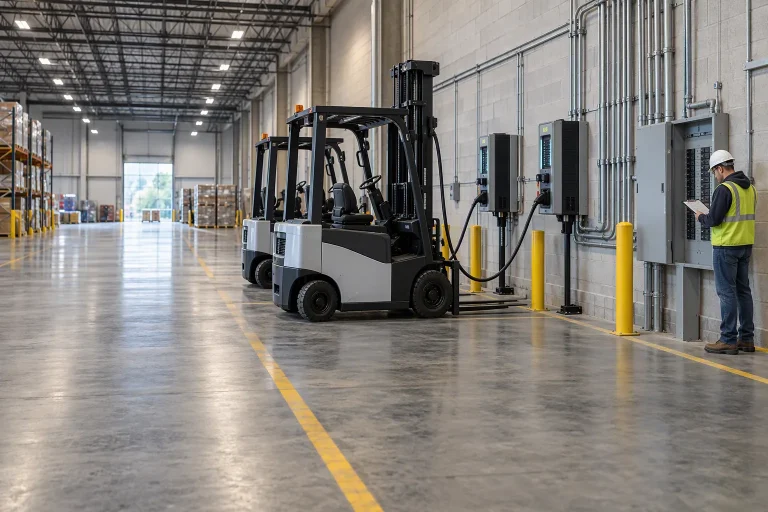
If the plan involves electric trucks, settle the charging question in the same conversation. Charging behavior shifts at low temperature. What the infrastructure costs to install depends on where the chargers sit relative to the cold.
Cold storage forklift operations reward specification discipline more than almost any other application. The building will find every shortcut eventually.
FAQ
Frequently Asked Questions About Cold Storage Forklift Operations
How many refrigerated warehouses are in South Carolina?
Twelve, holding 76.8 million cubic feet of gross space as of October 1, 2025, according to USDA figures published in February 2026. Seven are public facilities and five are private or semi-private. The state accounts for a small share of national refrigerated capacity.
Why do forklifts fail faster in cold storage?
Temperature cycling rather than cold itself. Moving between a near-ambient dock and a freezer condenses moisture on cold steel, which then freezes. Water reaches electrical connectors, ice builds in mast channels, and the resulting faults look unrelated until someone maps them.
Can a standard forklift work in a freezer?
It will run at first. Trucks built for cold duty use sealed connectors, conditioned hydraulic fluid, heated operator positions and corrosion-resistant finishes for a reason. A standard machine placed in a freezer tends to show the consequences several months in rather than immediately.
What does NIOSH recommend for employees working in cold rooms?
Keeping deep core body temperature above 96.8 degrees Fahrenheit and indoor air velocity at or below 200 feet per minute. NIOSH also suggests rotating tasks after breaks, limiting fine-dexterity work in the cold, and placing warm air dryers outside the room.
How does cold storage change forklift specification?
Settle the temperature range the truck will actually see, how much of a shift sits below freezing, whether it crosses between zones, and the floor condition once meltwater reaches it. Those answers drive the conditioning package, tire compound, battery sizing and cab choice.
This article is general industry information and is not a substitute for OSHA powered industrial truck training, your employer’s safety program, or the operating manual for your specific equipment.
Piedmont Forklifts: Rentals and Sales Across the Upstate
Piedmont Forklifts is a woman-owned forklift sales, rental, and service company in Spartanburg, South Carolina. We work on every make and fuel type, so one shop covers a mixed fleet.
Our Services Include:
- Forklift RentalsDay, week, or multi-month rentals sized to the job
- Forklift SalesInspected pre-owned forklifts matched to your load, lift height and aisle width
Spec’ing a truck for cold work? Contact Piedmont Forklifts with your temperature range, your zones and how much of the shift runs below freezing.
Works Cited
- United States, Department of Agriculture, National Agricultural Statistics Service. Capacity of Refrigerated Warehouses, 2025 Summary. Feb. 2026, esmis.nal.usda.gov/sites/default/release-files/795764/rfwh0126.txt.
- United States, National Institute for Occupational Safety and Health. Preventing Cold-related Illness, Injury, and Death among Workers. DHHS (NIOSH) Publication No. 2019-113, Sept. 2019, www.cdc.gov/niosh/publications/numbered/2019-113.html.